
Reservoir characterization
Integrate optical thin sections with SEM, XRD and cathodoluminescence to determine lithology, pore types, diagenetic alteration and depositional controls on reservoir quality.
A direct route from mineral and textural relationships to reservoir quality, pore-system behaviour and geological prediction.
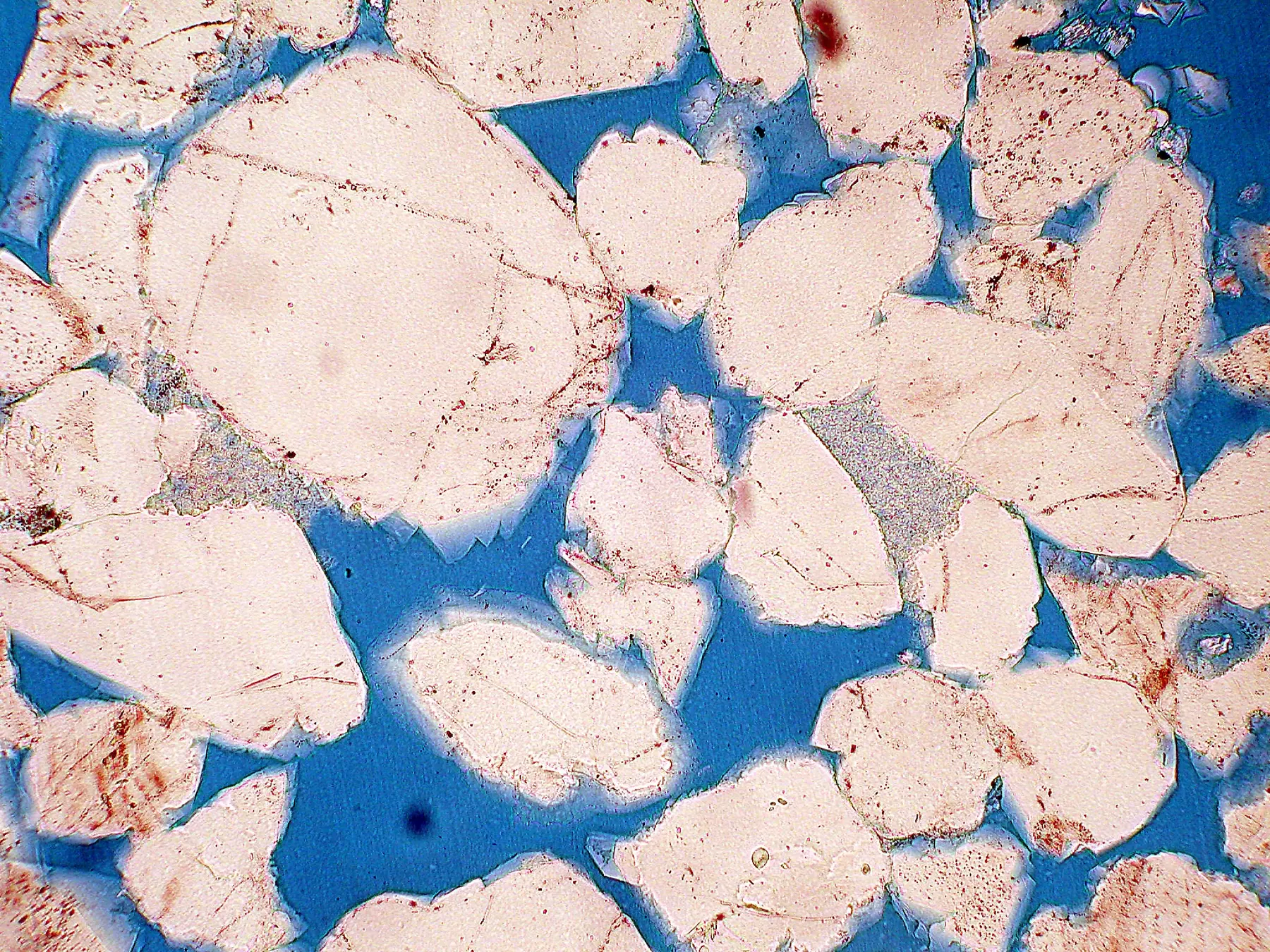
Optical thin-section petrography is valuable as a stand-alone method and becomes even more powerful when integrated with SEM, XRD, cathodoluminescence, core analysis and well logs.
Integrate optical thin sections with SEM, XRD and cathodoluminescence to determine lithology, pore types, diagenetic alteration and depositional controls on reservoir quality.
Identify pore types and connectivity, and quantify pore geometry, size and shape—particularly valuable for cuttings, sidewall cores and unconsolidated samples.
Reconstruct compaction, cementation, dissolution and replacement, linking mineral reactions to burial conditions and reservoir-quality trends.
Relate mineralogy, texture, clay distribution and pore types to NMR, density, gamma-ray and porosity responses.
Cluster measurable mineralogical and textural attributes into geologically meaningful rock types that explain petrophysical behaviour.
Use quartz varieties, feldspars, lithic fragments and heavy minerals to interpret source, transport, maturity and basin evolution.
Evaluate reactive minerals, clays, fines and pore-lining phases that may interact with drilling, completion, stimulation, injection or production fluids.
Tell us about your samples, subsurface questions and project objectives.